
(With very humble apologies to Eliot Weinberger.)
Yesterday, we heard some different stories. The director of Bwafwano Community School and Home-based Care Service - which serves a community of 70,000 poor people on the outskirts of Lusaka - told us that although official statistics say that 68% of Zambians live on less than $1 a day, in her community she suspects the true figure is closer to 95%. We heard her insist that policies imposed by the International Monetary Fund (IMF) and wother lending institutions were to blame for this poverty.
Later, we heard the resident representative of the IMF say that the main Lusaka hospital was 'horrible', and that he would 'rather die than go there'. We heard him ask what he could do, and dispute that IMF salary caps for public workers were adding to the appalling drain of skilled healthcare staff out of the country. He admitted that the IMF suggestion of adding VAT to food and mostquito nets was 'insensitive' and probably should not have been made. We also heard him say that parliament should not have the right to scrutinise loan agreements, and that he  didn't think the IMF should try to be more active in making its information available. We heard him say that he thinks the IMF does better when it is 'lurking in the background'.
Yesterday and today, I also heard what campaign groups are doing in Zambia, separately and together. I heard about the launch of Mine Watch Zambia, which is revealing and examining the terms under which Zambia's mines were privatised. I heard Nachilala Nkombo of Jubilee Zambia say how much we have achieved and will achieve working together. And I heard Emily Sikazwe (pictured left) of Women for Change say, 'The struggle continues'.
Wednesday, January 31, 2007
What I heard in Lusaka


Monday, January 29, 2007
Brain drain

The doctors, nurses and other healthworkers we have met so far have made a heartfelt plea to improve salaries and conditions to stem the brain drain from the health system. For instance, Dr Evaristo Kunka – one of three government-employed doctors in Siavonga district, home to 70,000 people – explained how most of his classmates now earn four times as much in Namibia or South Africa. But he also explained why he stays: ‘When you get in these rural areas, you see real poverty. We complain about our salaries, but there are people out there who really need our help.’
But at the Finance Ministry, the need to pay doctors more was just one item on a huge government wish-list. The government currently has a funding gap of over £370 million for its national development plan. Debt relief from the G8 deal is saving money: but only about £25 million this year. This is necessary – but not nearly enough. And there is still the concern that if the IMF imposes limits on what the government can spend, even having more resources is of little help. (The Finance Ministry also became last in a long line of places where we heard about the abuse of tax breaks in Zambia by transnational companies.) Today, we also saw Mulima Akapelwa who spoke at the human chain around the G8 summit in Birmingham in 1998, and at the Make Poverty History G8 rally in Edinburgh in 2005. She argued that, ‘The people themselves should set their own conditions, with the government, not the IMF. The government should say: “These are the conditions the people want, in terms of transparency and accountability.”’ We spoke with Emily Sikazwe and some of the other staff at the immensely inspiring Women for Change organisation. They talked about their work with women and men in the most rural areas – and of the need to avoid a new debt crisis by dealing with Zambia’s poverty situation and IMF conditions: ‘If you cancel debt and still keep creating an environment where new debt is needed in future, then you still have a problem.’
Sunday, January 28, 2007
Whose country is it anyway?

Talking to partner organisations, politicians and frontline workers in Zambia reveals considerable concern about how the benefits of debt cancellation can be properly felt – and in particular, who is making the relevant decisions.
Zambia has had over 90% of the debt that it owed at the end of 2004 cancelled – a large chunk of that thanks to the debt deal agreed by the G8 in 2005 after enormous campaigner pressure. But that is, of course, not the end of Zambia’s problems. The full impact of the debt cancellation will be felt over time, and meanwhile the International Monetary Fund (IMF) is continuing to attach conditions to new loans that are making it very difficult for the country to deal with its problems.
For instance, Jubilee Zambia and partner organisations are particularly concerned about the tax reforms being pushed by the IMF as a condition of the new loan agreement that is currently being negotiated. These include a proposal for VAT on food, books, mosquito nets and transport. (Bear in mind that foreign companies have a five-year tax holiday on all new investment, including in newly privatised enterprises.) We have met with opposition party MPs who are lobbying hard for parliamentary scrutiny of all loan agreements, to give them a chance to examine and veto such conditions. Jubilee Zambia is calling for a similar law. The IMF,  however, is opposed: it says that involving parliament in such discussions will make them ‘drag on’ and will politicise the issues. Because of course in the IMF-world, proposing VAT at 17.5% on food in a country where official statistics report that 60% of people are suffering chronic malnutrition, is not ‘political’, nor a proper subject for the country’s elected representatives to debate.
Meanwhile IMF conditions on the use of government money are limiting the possible benefits of debt relief. For instance, the abolition of healthcare fees is in one way increasing access to doctors and medicines. But limits on wages for healthworkers make it extremely hard to recruit the necessary staff: so clinics are left empty, and the chronically ill are left untreated. Zambia needs to be given more funds, and – crucially – the freedom to invest in essential services.
Friday, January 26, 2007
From the Forum to the Future

Caroline, with most of our Jubilee US party, left early on Thursday to go to Zambia to meet debt campaigners and look at some of the effects of debt cancellation. Meanwhile, those of us still in Nairobi finished the Forum, and have been undertaking evaluations, meetings and planning.
Marathons in the searing heat from some of Nairobi’s worst slums led to the Closing Ceremony in Uhuru (Freedom) Park in the centre of Nairobi. Having thousands of the countries’ poorest people lead the procession reminded us all of our main focus. Then orators and musicians from around the world helped us celebrate the Forum’s vision. Many of the world’s most disadvantaged people – such as the Saharawi from Africa’s last colony, in the Western Sahara – processed at the ceremony and shared their unfashionable causes with us.
The Forum has been an enormous undertaking. Not surprisingly for an event which wants to give as much freedom and ownership as possible to its participants, there were some logistical problems. Also there is an inevitable tension between maximum accessibility and reasonable security. But overall, the Forum has been a great success, enabling people from all levels of society and from all over the world to address the needs of those who are forgotten at meetings like the World Economic Forum in Davos. Let’s hope that the strengthened networks and energy of Nairobi 2007 help us remember - as "You negotiate ... We die" on the T-shirts reminded us - the urgency of making real progress if more lives are not to be wasted. 
Thursday, January 25, 2007
A March and a Walk to Different Worlds
 Yesterday was the day of the Debt March at the World Social Forum, stressing the Forum theme that we can create a different – and fairer – world. Thousands of people collected in the Debt Free Zone – with drumming, dancing, chanting and tremendous energy – to send the messages round the Forum: “Debt Kills” “An End to Debt: An End to Poverty”. “Don’t Owe. Won’t Pay.” “Debt is Poverty. Debt is Slavery. Refusing to Pay is Justice”. Banners also highlighted the terrible debt statistics, such as 22% of Kenya’s budget being spent to service their debt, while millions are illiterate and die of preventable diseases.
 The day included, too, thought-provoking analysis (like a seminar on Strategies for Economic Justice under Globalisation, from International Development Economics Associates from around the world); detailed practical discussions and planning (like how to avoid the dangerous effects of debt in post-conflict countries like Liberia and the Democratic Republic of the Congo – they want to avoid the suffering Sierra Leone’s debt travails have caused in the three years since the end of its civil war); and key networking (such as the development of the World Social Forum Declaration on Debt, the culmination of many discussions at all hours during the Forum).
 To keep our feet on the ground and remind us of why this work is important, I accepted an invitation from a youth group from Korogocho, a slum around the rubbish dumps 10 minutes’ walk but a world away from the splendid stadium. Living in corrugated iron and cardboard shacks, squeezed among rat-infested piles of rubbish and rivers of sewage, the young people showed us their homes and, with laughter, drumming and dancing, celebrated the work of their groups focusing on handicrafts, football, removing garbage and other income-generating and empowering activities. With such intrepid and visionary young partners in the fight against poverty, surely we must win.
Tuesday, January 23, 2007
Slum Kids and Nobel Prize Winners Raise Hopes

The two-year-old Global Call to Action Against Poverty has now involved more than 50 million people in more than 100 countries. The World Social Forum provides an opportunity to share experiences and plans, strengthened by visions like those in the songs of the young men from Nairobi’s Korogosho slums, the Hope Raisers: “G8, We’ve got a question for you. Why do you want us to suffer; why do you want us to perish? You know we are the creditors. Cancel debts. Cancel debts.” I hope to bring their DVD back for UK campaigners to share their optimism and energy.

Liberia has tremendous opportunities, with its devastating civil war at last finished and Africa’s inspiring first woman President leading a democratic government. These opportunities are matched by the challenges of huge debt, minimal services, destroyed infrastructure and people’s high expectations. In the light of this vulnerable situation, it was good to meet with some Liberian civil society leaders. We discussed how we could help the rich world leaders realise the urgency of – and quickly deliver – debt cancellation for Liberia.
Another session gave an opportunity to people from around Africa – including Senegal, Kenya, South Africa, Angola, Ethiopia, the Gambia, Zimbabwe – to discuss their debt histories, current situations and ways forward. Debt relief has transformed millions of lives, in spite of the associated undemocratic and harmful conditions. Hope is high for more progress.
Meanwhile, charismatic civil society campaigners – like Mary Robinson and Wangari Maathai – complemented the Hope Raisers in renewing our visions of a better world.

Monday, January 22, 2007
Doing what we can

My high point today has been hearing a very powerful and moving speech from Professor Wangari Maathai, the first African woman to win a Nobel Prize. (The low point was realising that my voice recording of her speech hadn’t worked – but we are hoping to get a copy of a video recording.) She spoke of the illegitimacy of much of the debt claimed from poor countries – the fact that creditors lent irresponsibly knowing that the money was not going to help the poor, or knowing the countries couldn’t afford loans – and how today ‘the poor are being sacrificed so that debts can be serviced.’
But she also spoke about what we can achieve together, with the commitment to “do what we can, whatever we can, wherever we are.” She reminded us that, ‘We are loud enough to be heard by all G8 countries, to be heard saying “These debts are illegitimate - and you know it.” We can shout from Nairobi and be echoed in Europe, in North America, in Latin America, in Asia and Australia. Because there is no part of the world where we are not represented.’
The determination to do what we can seems to be the theme linking everything and everyone here: from those taking part in the angry debates about China’s role in Africa that I heard this morning, to the band I can hear behind me now singing about access to water (‘H – 2 – oh-oh-oh’, etc). There is a wide variety of perspectives, and even more so of experiences. About an hour ago I stopped to take a picture of an AIDS ribbon tree, commemorating those killed by AIDS. The man beside it asked me to take a ribbon, and write on it the name of someone I know who has died from AIDS. As I hesitated, he said ‘Any one of them will do.’


Sunday, January 21, 2007
Washing Away Dirty Debts

Coming to the World Social Forum has been like being part of a brook, joining a stream, flowing into a river and finally helping to form the ocean. We gradually joined up with groups of people from all over the world: coming into Nairobi, registering at the Kenyatta International Conference Centre, joining the march to the rally in the Uhuru Park (culminating in our forming a colourful and deep pool of people at the feet of one of Africa’s great visionaries and founding fathers, Zambian ex-president, Dr Kenneth Kaunda) and then, today, in hundreds of buses coming to the Moi International Sports Centre, Kasarani, where section of seats have been tented off and other tents erected to form hundreds of separate display, conference and seminar rooms.
Like many different types of water, the people have tremendous diversity (of nationality, affluence, age, perspectives, preoccupations), but, again like flowing water, there is amazing strength and energy, bubbling into debates, drama, declamations, demonstrations, all backed by continuous drumming and dancing. Surely we should – together – be able to tackle the obstacles in our path – from the boulders of power cuts, printing failures, and internet disconnections that make local progress difficult here to the mountains of greed, vested interests, lack of political will that dominate the global landscape.
Building on the Forum’s slogan, “Another World is Possible”, Kenneth Kaunda reminded us, this “summit of the people of the world” must denounce all exploitation of people by people. He asserted that one of the major consequences and causes of poverty is debt; although several battles have been won, the debt war is not over. Through civil society and social movements across the world working together, we have made tremendous progress, but we must do more.
Today we have had discussions with partners in many countries – of debtors and creditors – on illegitimate debt, responsible financing, conditions attached to debt relief and the special needs of post-conflict countries such as Sierra Leone (which has been given substantial debt cancellation) and Liberia (which, so far, has not). This is helping to clarify the next steps and how we can best work together. Each of us is a drop, but our united torrent can totally wash dirty debts away and transform the landscape.
Saturday, January 20, 2007
World Social Forum 2007: Nairobi
 The 2007 World Social Forum in Nairobi is the first to be held in Africa. Arranging a one-off conference for around 100,000 delegates from campaigns and social movements around the world - there to discuss econmic justice, peace and conflict, human rights, women's rights, land, HIV/AIDS, etc etc - is obviously always going to be a monumental task. And the spirit of the WSF means that it is largely ‘self-organised’ by participants – that is, the organising committee provides the space and the staff and the volunteers and the security and the technology and all the rest, but the participants themselves register and organise the events. There are understandably hiccups along the way (the meetings start at 8.30am tomorrow morning, Sunday, and it still seems to be impossible to get our hands on a programme) but there is a huge amount of energy and people are finding their own way around it (little programmes of a few events, printed by the event organisers, are everywhere).
This afternoon we were with colleagues from Jubilee South, Jubilee USA, Jubilee France and  others at the opening rally at Uhuru Park. (‘Uhuru’ being the Swahili word for independence / freedom.) There were speeches, songs, dances, poems – and a promising array of slogans and calls to action, on banners, t-shirts, badges, etc. Many were variations on the official WSF slogan of ‘Another world is possible’. (‘Another Kenya is possible’; ‘A world without AIDS is possible’.) Or some just went their own way. (‘When Bush comes to shove, resist!’)
There was also a special address from Zambia’s former president Kenneth Kaunda. He spoke of how, when Zambia was experiencing debt problems and trying to escape IMF control (thus bringing down the wrath of creditors), it was not so much other governments that stood in solidarity with his country, but the individuals who make up the debt movement worldwide. He spoke of how the debt campaign has taught us that individual campaigners from the countries of the South and the North, working together, can have an amazing impact. And he called for further action: “Being here at the World Social Forum 2007 must inspire us to do more and liberate ourselves from the burden of debt. We have achieved, and we can achieve still more.”
Tuesday, November 14, 2006
Hiatus
As this blog was intended to update readers on activities and news during the Month of Action in September and October, it's currently in hiatus. We may well decide to activate it again in the future, for other events, and if and when this happens we will advertise the fact via our website, www.jubileedebtcampaign.org.uk
Thank you to those who visited regularly!
Tuesday, October 17, 2006
Millions stand up!

The figures are in from around the world and it looks like 23, 542, 614 people took action as part of the Stand Up Against Poverty world record attempt this weekend. The picture above is from this morning's action in Trafalgar Square announcing the total - more from around the world at WhiteBand.org.
With a reported 20 million people taking part in the Philippines alone, however, there are already calls coming in for a recount...
Monday, October 16, 2006
Engaging with Hilary
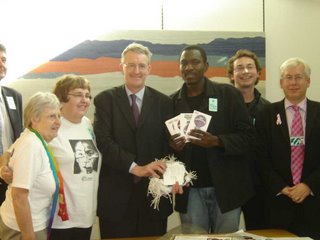 In the meeting with Hilary Benn at Portcullis House on Thursday, we managed to speak with him for nearly an hour on conditionality attached to debt relief.
Boardroom style, with Mr. Benn and his cohorts at the end of the table and the fourteen of us surrounding him, the format was actually fairly informal. We started off with a bang, asking him straightaway what specifically he would require to release the £50 million worth of funding to the World Bank. Although he avoided the issue, just as most politicians, he said he would know once he gets the report from the World Bank.
What would he like to see in the report? The truth.
What will he do when he gets the report, will he release the money or will he hold back more? He will decide that once he gets the report, ‘you can’t put the cart before the horse’ type of answer.
How will he make his judgement, what specifically will make him happy? If the World Bank is moving in the right direction, that is progress. It does not happen all at once.
Typical politician though he is, Hilary Benn is a great speaker, particularly good at dancing around the issues. But accolades to  him for even agreeing to speak with us. He is very passionate when he speaks, and he does genuinely seem to care about the issues. Holding back the £50 million – despite being such a relatively small amount – is a great start. If the amount wasn’t enough, his timing was impeccable, sending a message to the World Bank to get their act together, if nothing else. Now we just need to make sure he follows through with that message in November when he gets the World Bank report, and February/March when discussions about the next round of World Bank funding begin.
Hilary is still farther away then we’d like him to be on issues of debt relief and conditionality…but he is a lot closer than many other politicians – just ask him yourself, he will tell you. Several times he called for our help to garner support from other countries so that he will not be alone in the debate. To an extent, he is right. The UK is very progressive – compared to most countries, that is. We did remind him of good ole Norway who has taken the great leap of cancelling debt which they have taken responsibility for, calling it irresponsible lending on their part. He seemed unaware of this action, but perhaps his ill preparedness will cause him to consider it further…we can hope.
Despite his seemingly good intentions – there are still issues that many of us would argue with him. For instance, his insistence that HIPC conditions cannot be revisited. There is also still quite a grey area, where he considers conditions to be either good or bad. For him it is not an issue of whether or not we have conditions, but "which conditions". Some of what he considers to be good conditions, however, is rather alarming. At one point he was ranting about how inflation hurts the very poor, implying that the regulation of inflation is not a "bad" condition. First off, the correlation between low inflation and a robust economy does not exist! Many economists disagree on the issue, and there is no generally accepted proof on the effect of inflation. Secondly, imposing conditions from the top is not the way to strengthen and encourage democracy. In the past, these macroeconomic conditions have shown how they can be more detrimental than beneficial to host-countries (e.g. IMF policies and East Asian financial crisis of 1990s).
We still disagree on many issues, especially when it comes to "good" versus "bad" conditions. Mr. Benn often referred to his favourite bad conditions – trade liberalisation and privatisation. Clearly, he needs more convincing, if that is where is train of thought ends. At least we know he is listening. Even when he avoided questions, gave a vague answer, or went off on a tangent (most notably why WDM is awful), he was engaging with us. Fortunately, there were many great questions posed towards Hilary Benn, as well as some excellent responses to his mini-speeches – so this meeting was not meaningless. A couple of times he even seemed genuinely stumped.
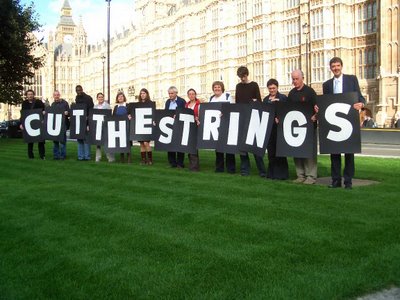
Overall, I think we gave the impression of a well-informed group who obviously cares about poverty alleviation and cutting the strings. Most importantly, Hilary Benn knows the numbers of supporters there are, and that we are not going anywhere. We will be watching as he makes his decisions, and we will hold him accountable.
Tuesday, October 10, 2006
Global warming - global debt
As part of the GCAP Month of Action, I have anumber of speaking engagements on climate change. But how does this relate to debt relief? In brief...
The scientific evidence is now overwhelming - climate change will overwhelm the entire globe, bringing unimaginable calamity on our own children or grandchildren, unless vigorous action is taken as a matter of urgency. "Never before have we faced such a global threat… The longer we procrastinate, the more difficult the task becomes" (Lord Robert May, President of the Royal Society).
But the world's poor will suffer first and most – "The impacts of climate change will fall disproportionately upon developing countries and the poor… within all countries" (Intergovernmental Panel on Climate Change). Indeed, there is strong evidence (from climate labs of the highest standing) that they are already suffering severely from the effects of our polluting life style - "Climate change, largely caused by greenhouse gas emissions, may already be responsible for… a drop in rainfall since 1996 in Ethiopia and surrounding..." (Lord Robert May).
So does this mean, debt relief and trade justice are no longer as important as once we considered them to be? NO, A THOUSAND TIMES NO! Indebted poor countries are going to need all the help they can get to weather the storms now metaphorically and literally brewing on their horizons. Climate change simply adds one more reason why we have an obligation to stop pussyfooting around and 'Drop the Debt!'
Friday, September 29, 2006
Africa on the sideline
This year I´m working with African Network and Forum on Debt and Development (AFRODAD). When I´m observing the latest international summits unfolding, from the G8 in St. Petersburg in July to the World Bank and IMF annual meetings in Singapore last week, it strikes me that from an African perspective one must feel a bit sidelined this year. While 2005 was the year when celebrities like David Beckham and Brad Pitt pledged to make poverty history, when 15 million people wore white bands, and when more than a billion people gathered in front of the their TV-sets for Live8, 2006 seems to be a bit of an anti-climax. As was reflected in editorials in some African newspapers during this summer´s G8 meeting: - It´s the G8 meeting, but where is Angelina Jolie? Last year Africa was in the spotlight and on the catwalk. This year Africa seems, in lack of better ways to put it, somewhat out of fashion.
Under any circumstances this would be a reason for concern, but in many ways this lack of attention comes at a time, in particular, when public pressure on issues like third world debt, conditionalities, and reform of the international financial institutions (IFIs) need to escalate, rather than evaporate. While the pledges made at Gleneagles where far from sufficient, some processes were started during last year that needs to be kept at the forefront of public attention. First there is the issue of debt relief, but other critical developments are also unfolding as we speak. Some governments are now calling for reform of World Bank and IMF conditionalities, there is a big row over the anti-corruption strategy of World Bank president Paul Wolfowitz, in the IMF developing countries are demanding a greater say and Gordon Brown said earlier this year that the institution´s legitimacy depend on it, the World Bank is currently trying to delay their own promised study on the issue of illegitimate debt, and, finally, the inconsistency of the good governance agenda promoted by the IFIs have been put at open display in Singapore last week. For those of us who are advocating for change in these institutions, this is the time to let our voices be heard.
That´s also why the civil society actions referred to on this blog are so important. Next year the G8 is returning to Germany, eight years after 50.000 people made, what in those days were seen as, groundbreaking calls for debt cancellation. Since then campaigners have made significant progress, but also been victims of politicians´ spin. As debt relief has become mainstream, it has become difficult for the public to distinguish campaigners´ call for debt cancellation and politicians support for debt relief. This year, and the coming year, we should make sure we tell a story that distinguish us from the people we are to influence. A story that distinguish charity from justice. A story that is calling, not only for the cancellation of unpayable debts, but also the cancellation of illegitimate debts. And a story where we support Southern governments´ right to repudiate such debt. It´s a story where we, as JDC and other groups, call for rich country governments and IFIs to cut the strings. And it´s a story where we, as Christian Aid did last week, call for our governments to hold back their funding to the IFI until they accept radical reform. By telling such a story we could create a broader and more long-lasting momentum for change - a momentum that goes beyond the celebrity hype.


